Google announced an official Google Trends API on July 24, 2025, and it is still an alpha on November 21, 2026. Access is by application only. Developers fill in a form on Google's alpha page, and Google admits a limited number on a rolling basis. The alpha returns consistently scaled search interest over a rolling 1,800 days, about five years, with daily, weekly, monthly and yearly aggregations and region and sub-region breakdowns. It returns search interest, not absolute search volume, and Google has published no price, quota or endpoint list for it. The Trends API covers the same job today with no application: one POST returns the Google Search series for a keyword, about 260 weekly points, at one request per source.
The call that works today
No public endpoint exists for Google's alpha, so there is no call to show for it. This is the call that returns the same underlying Google Search interest right now, through the Trends API docs:
curl -X POST https://api.trendsapi.ai/api \
  -H "Authorization: Bearer $TRENDS_API_KEY" \
  -H "Content-Type: application/json" \
  -d '{"mode": "get_time_series", "keyword": "google trends api", "source": "Google Search"}'
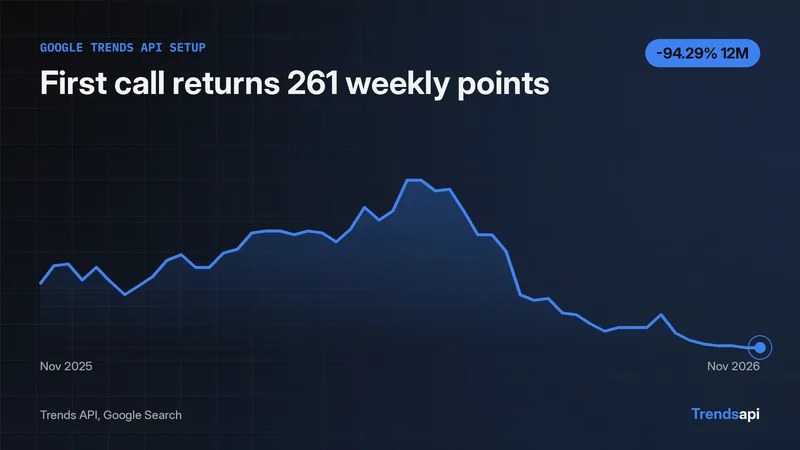
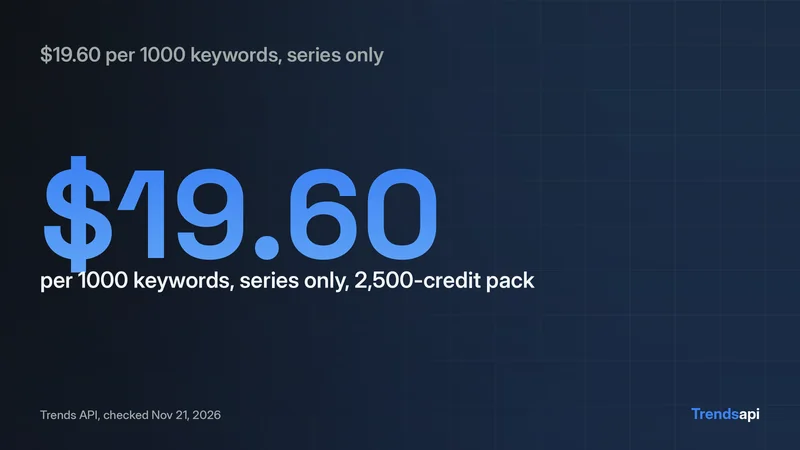
The response arrives with the series inside body, a JSON string to parse again before reading the points. Each point carries a date, a value on a 0 to 100 index, and a volume where the source has one. The call above returned 261 weekly points for "google trends api", from November 20, 2021 to November 14, 2026. It costs one request per source. The free tier includes 100 requests a month, and the pricing page lists the paid tiers.
What the alpha is
Google's announcement, posted July 24, 2025 by Daniel Waisberg and Hadas Jacobi of the Google Trends team, describes an API for programmatic access to Google Trends data. The point of it is the scaling. On the Trends website, every request rescales its results from 0 to 100, so two requests cannot be compared directly. The API scales its data consistently across requests, which lets a developer join, compare and merge data from multiple requests, compare dozens of terms at once, and pull only the latest period when monitoring a term over time instead of re-pulling the full history each time.
The history runs back 1,800 days, about five years, and up to two days ago. Four aggregations are offered in the same API: daily, weekly, monthly and yearly. Geography covers region and sub-region breakdowns, as defined in the ISO 3166-2 standard. One limit stays in place: while the API returns consistently scaled data, the numbers reflect search interest, not absolute numbers. No route in the alpha returns a count of searches.
Who can apply, and what the form asks
Google publishes no eligibility list. Any developer can apply, and Google decides who gets in. The announcement says access opens on a rolling basis to a limited number of developers over the coming weeks, and the alpha page still carries the same message almost 16 months later: it is accepting applications for alpha testers. That page was checked on November 21, 2026, and it still reads as an alpha with no self-serve sign-up.
The application form asks for first and last name, an email address, and a Gmail account, which the form says is required to access the Trends API. It also asks for a verified domain, meaning the URL of the applicant's organization website, plus a description of the research or project objective, the expected outcome, and how the research results and data will be shared. A Google Cloud Console Project ID is optional. If a request is approved, the project ID is used to speed up access provisioning. It must run 6 to 30 characters, use lowercase letters, digits or hyphens, start with a lowercase letter and end with a letter or number.
Google frames the alpha as a test, not a launch. The announcement asks for developers who like testing and iterating with tools that might not be production-ready, and who will give feedback as the product develops. No wait time is published, and no applicant can check a queue position. The practical read is plain: apply with a concrete project, and build on another route in the meantime.
What the alpha does not give you
Four things are missing from Google's own pages. There is no published price, no published quota, no public endpoint list, and no general release date. The alpha page links only to the application form. A developer who is not accepted has no documented way to call the API at all.
The scope is also narrow. The alpha covers Google Search interest only. It does not cover YouTube, TikTok, Amazon, Reddit or any other platform, and it does not return absolute volume. The Trends website caps a comparison at eight terms; the alpha removes that cap by comparing dozens. That is the whole gap the alpha closes: consistent scaling, a five-year window in one call, and comparisons beyond eight terms.
Search interest in the alpha has faded
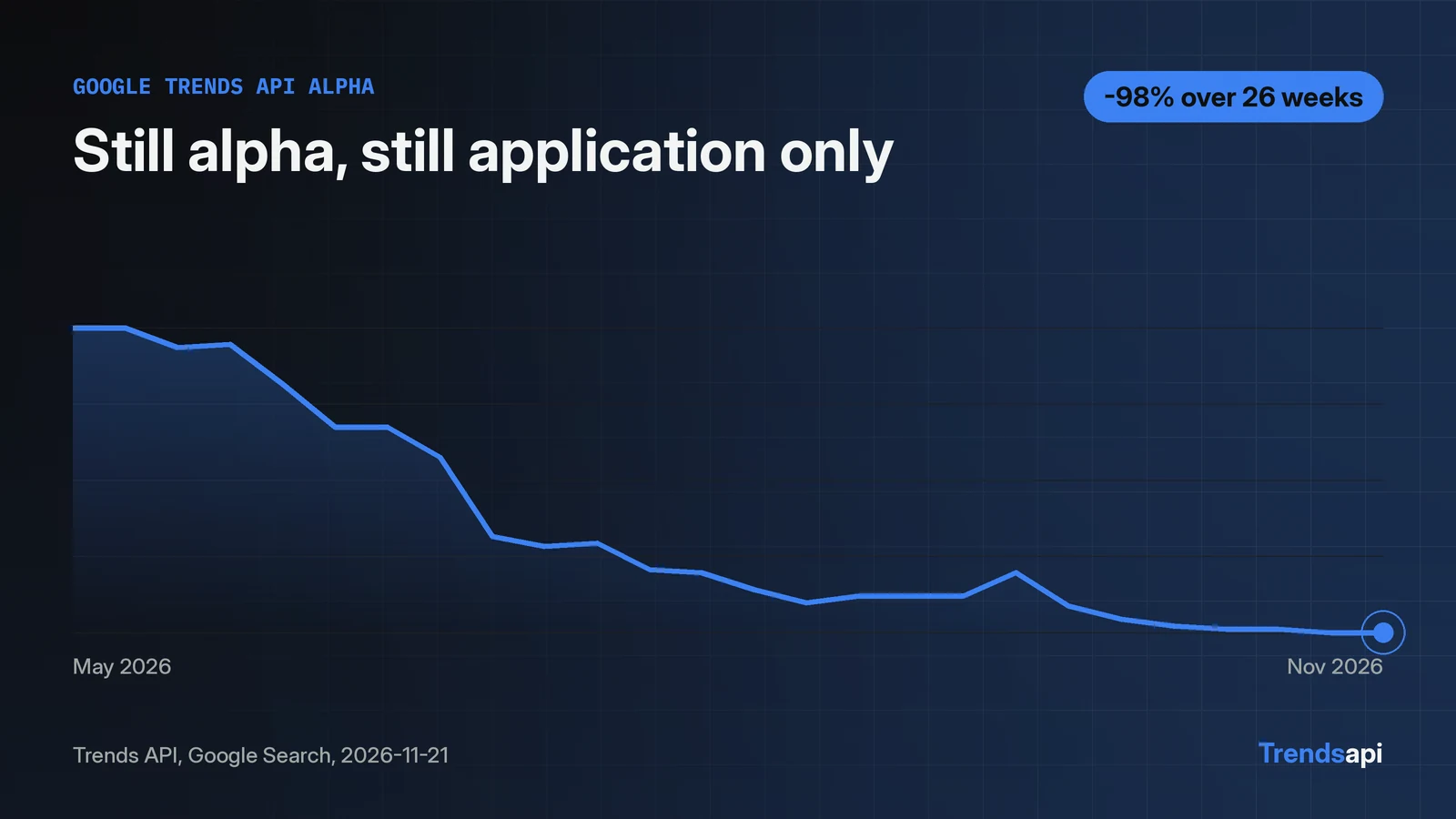
The Trends API series for the phrase "google trends api" shows how attention moved while access stayed closed. The series peaked at 100 in the week of August 16, 2025, three weeks after the announcement. The latest weekly point, November 14, 2026, reads 2. Over the last three months the index fell 90 percent, from 20 on August 15, 2026 to 2. Over twelve months it fell 94.29 percent, from 35 on November 15, 2025 to 2.
The data shows interest fell. It does not say why. One reading fits the dates: the announcement drew a spike, then attention moved on while the alpha stayed closed to most developers. The numbers support the first half of that reading and say nothing about the second.
How the two routes compare
| Google Trends API (alpha) | Trends API | |
|---|---|---|
| Access | Application only, rolling basis, limited number | Free key, no application |
| History | Rolling 1,800 days, up to 2 days ago | About 5 years of weekly points |
| Scaling | Consistent across requests | 0 to 100 index per source |
| Geography | Region and sub-region, ISO 3166-2 | Country filter on Google sources |
| Absolute volume | No, search interest only | Where the source has it |
| Other platforms | No, Google Search only | 54 data sources |
| Price | Not published | Free 100 requests a month, see pricing |
| Start today | Only if accepted | Yes |
The comparison turns on access, not on the data. The alpha is the first-party source, and its consistent scaling is genuinely useful for anyone comparing dozens of terms or appending new weeks to old data. The Trends API is the route that works without an application, and its Google Search series covers the same five-year window. For most jobs, the difference that matters is the wait: one route starts today, the other starts when Google answers the form.
The Google Trends API page on this site shows the Trends API call for the live Google board, and the best Google Trends API guide compares the wider field of routes in one place.
FAQ
Can I sign up for the Google Trends API directly?
No. Google accepts applications through a form on the alpha page and admits a limited number of testers on a rolling basis. There is no self-serve sign-up, and no price or quota is published.
Does the alpha return search volume?
No. Google states that the numbers reflect search interest, not absolute numbers. The Trends API returns volume where the source has it.
What should I build on while waiting?
The Trends API call at the top of this page. It takes the same keyword and returns the same underlying five-year Google Search interest, scaled per source. If alpha access comes later, the data source changes but the keyword stays the same.