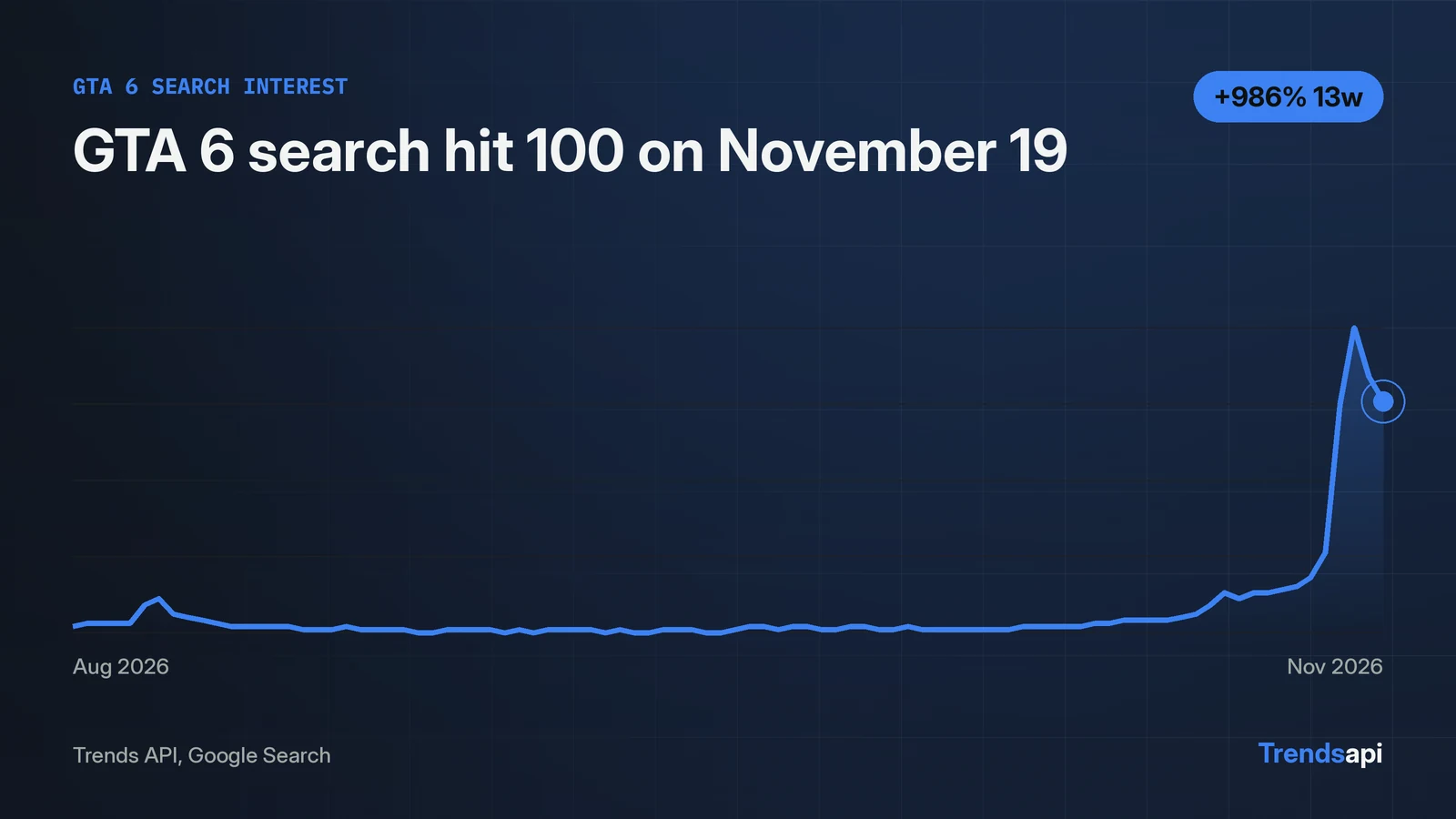
A single POST to https://api.trendsmcp.ai/api returns the daily GTA 6 search series; five more calls add the reviews series, the board ranks, the YouTube context, the Reddit check, and the growth figures. The call names mode get_time_series, keyword gta 6, source google search and resolution daily. It returned 92 daily points from August 22 to November 21, 2026. Search interest peaked at 100 on November 19, then eased to 84 on November 20 and 76 on November 21. The related query gta 6 reviews peaked a day earlier, at 100 on November 18, and held the No. 1 spot on the Google Trends board on November 22. The sections below show the working curl and Python for each call, the board ranks and YouTube context they return, and the growth call behind the three month figure.
Search interest peaked on November 19, then eased
The daily series stays under 20 through November 16, then jumps in the launch week. The table below lines the game query up against the reviews query for the seven days around the peak.
| Date | gta 6 | gta 6 reviews |
|---|---|---|
| Nov 15 | 16 | 3 |
| Nov 16 | 19 | 5 |
| Nov 17 | 27 | 19 |
| Nov 18 | 75 | 100 |
| Nov 19 | 100 | 91 |
| Nov 20 | 84 | 52 |
| Nov 21 | 76 | 57 |
Review searches spiked first and faded first. The game query peaked a day later and held up better after the peak. That order is what the data shows; the reason behind it is inference, not measurement.
One curl call returns the whole daily series
All calls below share one endpoint and one JSON body shape. Send the key as Bearer <key> in the Authorization header; the setup guide walks through creating a key.
curl -s -X POST https://api.trendsmcp.ai/api \
  -H "Authorization: Bearer $TMCP_API_KEY" \
  -H "Content-Type: application/json" \
  -d '{"mode": "get_time_series", "keyword": "gta 6", "source": "google search", "resolution": "daily"}'
The call returned 92 points in this run. Each point holds a date, an index value from 0 to 100, the keyword and the source. The last five points read:
[
  {"date": "2026-11-17", "value": 27, "keyword": "gta 6", "source": "google search"},
  {"date": "2026-11-18", "value": 75, "keyword": "gta 6", "source": "google search"},
  {"date": "2026-11-19", "value": 100, "keyword": "gta 6", "source": "google search"},
  {"date": "2026-11-20", "value": 84, "keyword": "gta 6", "source": "google search"},
  {"date": "2026-11-21", "value": 76, "keyword": "gta 6", "source": "google search"}
]
Daily resolution returned 92 days in this run, August 22 to November 21. A 401 usually means the key is missing or invalid. A 429 means slow down. The /pricing page lists the request limits.
A short Python client keeps every call in one place
One helper covers all four modes in this tutorial. It sends the body, then unwraps the reply in two steps: the outer response is JSON, and its body field holds a second JSON string. Decode that string once more to reach the list or object; skip the second decode and you hold a string, not a list.
import json, os
import requests

URL = "https://api.trendsmcp.ai/api"
KEY = os.environ["TMCP_API_KEY"]

def call(body):
    resp = requests.post(URL, headers={
        "Authorization": f"Bearer {KEY}",
        "Content-Type": "application/json",
    }, json=body, timeout=60)
    resp.raise_for_status()
    payload = resp.json()
    if isinstance(payload, dict) and isinstance(payload.get("body"), str):
        payload = json.loads(payload["body"])
    return payload

series = call({"mode": "get_time_series", "keyword": "gta 6",
               "source": "google search", "resolution": "daily"})
print(len(series))
print([(p["date"], p["value"]) for p in series[-5:]])
The run printed 92 and the same five tail points as the curl call: 27, 75, 100, 84, 76 for November 17 through 21. Without that second parse, the result stays a string instead of a list. The same helper serves the board, growth and context calls below. Only the body changes.
The board ranks reviews first, not the game itself
The get_top_trends mode with type Google Trends returns the live board as ranked pairs. The snapshot below is from November 22, 2026 at 09:01 UTC. Reviews led at No. 1, with gta 6 reviews ahead of the Hunger Games title at No. 2 and anthropic stock at No. 3. robert pattinson followed at No. 4 and fiona the hippo at No. 5. Three more GTA terms sat lower down: the online-mode question at No. 9, gta 6 metacritic at No. 10 and mandy gta 6 at No. 17.
Four GTA 6 terms sit in the top 25, and the reviews query leads the whole board. That lines up with the series: review searches peaked first, though they faded to 52 by November 20 while the game query held at 84. The board is a snapshot, not a series. Pair it with get_time_series when the shape over time matters. The GTA 6 search versus shopping piece runs the same comparison across sources for the launch week.
board = call({"mode": "get_top_trends", "type": "Google Trends", "limit": 25})
print(board["as_of_ts"])
print(board["data"][:5])
The run printed the timestamp 2026-11-22T09:01:37Z and the top five pairs. When the board feeds a dashboard that polls often, ask for a small limit; the /pricing page lists the request limits.
YouTube context shows what viewers actually watched
The get_context mode returns what people posted about a keyword in the last 7 days. The call body names mode get_context, keyword gta 6 and source YouTube; the Reddit check swaps in source Reddit. For gta 6 on YouTube it returned 10 videos in this run. The three most-viewed were:
| Video | Views | Published |
|---|---|---|
| GTA 6 WTF and Funny Moments! #3 | 2,902,949 | 2026-11-20 |
| The PERFECT Heist in GTA 6 (No Cops, No Alarms) | 1,953,485 | 2026-11-20 |
| GTA 6 Gameplay Walkthrough FULL GAME [4K PS5 PRO] - No Commentary | 167,320 | 2026-11-22 |
Funny moments and heist clips drew far more views than the full walkthrough, but the clips were published November 20 and the walkthrough on November 22, hours before this call, so the gap partly reflects age rather than format. Compare videos of the same age before choosing what to make next. View counts move while the piece is read, so treat them as the values at the time of the call.
The same mode on Reddit returned nothing in this run: the source reported itself unavailable, with a count of 0. A context call can fail per source while the rest of the API works, so check the count before trusting an empty result. The docs list which sources each mode supports.
Growth mode answers the 3 month question in one call
The get_growth mode compares a recent point with a baseline and returns the percent change. For gta 6 on Google Search it returned +912.5% over 3 months and +1520.0% over 12 months in this run.
growth = call({"mode": "get_growth", "keyword": "gta 6",
               "source": "google search", "windows": ["3M", "12M"]})
print(growth["results"])
One limit applies. The growth mode reads the weekly series, and that series ended November 14 in this run, five days before the daily peak. The 3 month figure compares 8.0 on August 15 with 81.0 on November 14. The 12 month figure compares 5.0 on November 15, 2025 with the same 81.0. Both figures are real, and both predate the peak. Use the daily series from the first section for anything that needs the launch week itself.
Two questions the data raises
Does the reviews query always lead the game query? Not necessarily. This run shows one launch week where it did. A second launch, or a quiet week, could flip the order. The pattern to test is whether review searches lead in other game launches too.
Which call belongs in a daily monitor? The board call for what is moving today, plus the daily series for the shape. Growth adds the longer view in a single call. Together the three calls give rank, curve and trend without storing any history locally.