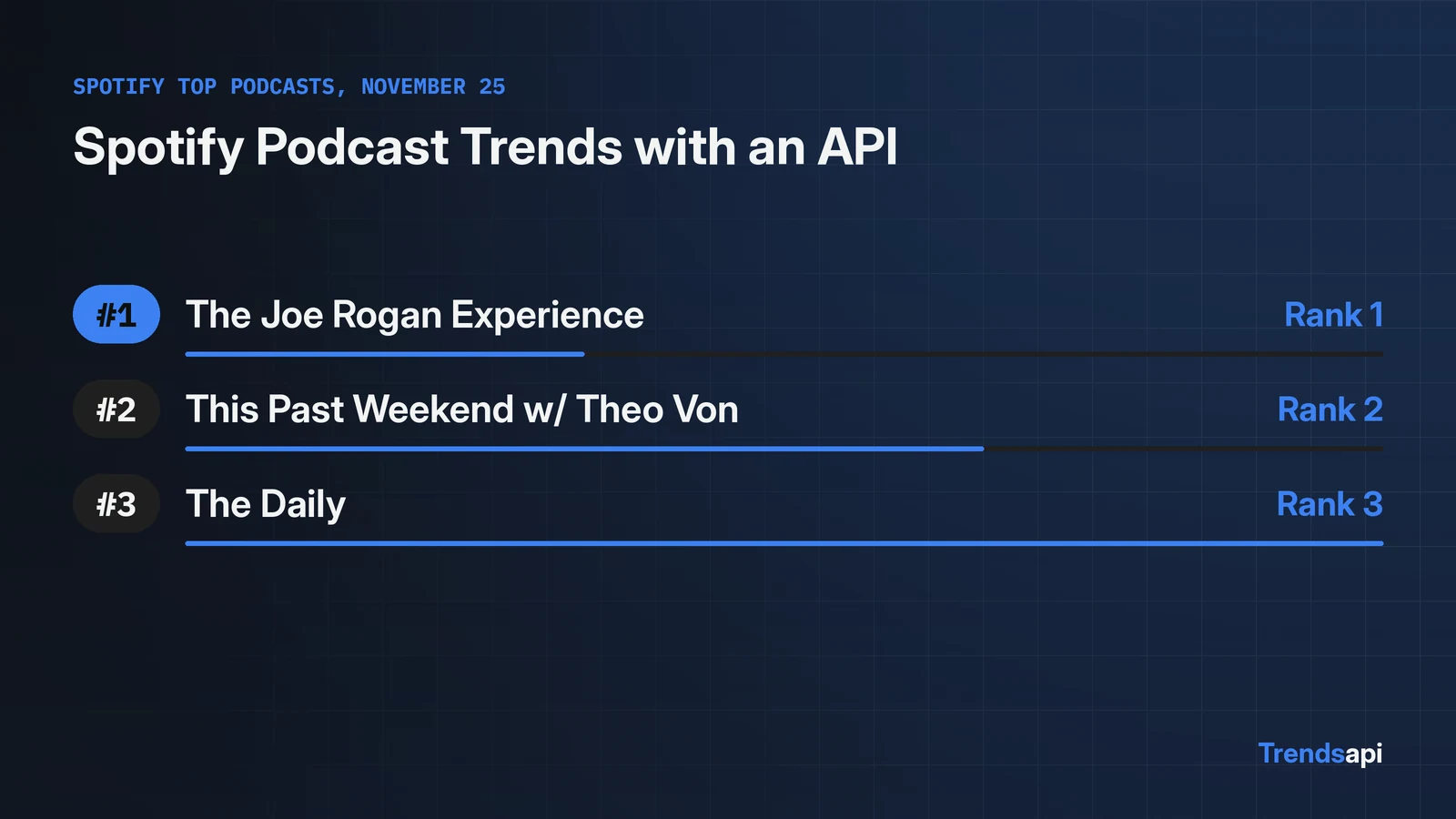
One mode, get_top_trends, with type Spotify Top Podcasts and limit 10 returns the leaders; adding sort rank_change with window 7d returns the climbers instead. The November 25 snapshot at 09:01 UTC placed The Joe Rogan Experience at rank 1, This Past Weekend w/ Theo Von at rank 2 and The Daily at rank 3. The fastest climber sat far below the leaders: The Fear Behind You reached rank 42 after gaining 92 places in seven days. Three short Python calls below fetch the leaders, the climbers and the next page of ranks, each run on November 25.
Fetch the leaders first
Board calls carry a board name rather than a keyword. A limit of 10 returns the top ten shows:
import json, os, requests

key = os.environ["TMCP_API_KEY"]
resp = requests.post("https://api.trendsmcp.ai/api",
    headers={"Authorization": f"Bearer {key}", "Content-Type": "application/json"},
    json={"mode": "get_top_trends", "type": "Spotify Top Podcasts", "limit": 10},
    timeout=30)
print(resp.status_code)
board = json.loads(resp.json()["body"])
print(board["as_of_ts"])
for rank, show in board["data"]:
    print(rank, show)
Output from the November 25 run:
200
2026-11-25T09:01:36.830938+00:00
1 The Joe Rogan Experience
2 This Past Weekend w/ Theo Von
3 The Daily
4 Crime Junkie
5 Good Hang with Amy Poehler
6 The Shawn Ryan Show
7 The Tucker Carlson Show
8 Up First from NPR
9 The Diary Of A CEO with Steven Bartlett
10 Matt and Shane's Secret Podcast
Each row pairs a rank with a show title. All three calls in this run returned the same as_of_ts value, 2026-11-25T09:01:36.830938+00:00, so the rows describe one snapshot rather than three separate moments. The board call in this run charged 1 request.
Leaders describe the top, climbers describe the movement
The five largest seven-day gains all landed outside the top ten. A leaders-only view therefore misses the movement entirely: the climbers list below starts at rank 42. Sorting by rank change over a seven-day window surfaces that movement. The baseline snapshot for the November 25 run reads November 18:
import json, os, requests

key = os.environ["TMCP_API_KEY"]
resp = requests.post("https://api.trendsmcp.ai/api",
    headers={"Authorization": f"Bearer {key}", "Content-Type": "application/json"},
    json={"mode": "get_top_trends", "type": "Spotify Top Podcasts",
          "sort": "rank_change", "window": "7d", "limit": 5}, timeout=30)
print(resp.status_code)
climbers = json.loads(resp.json()["body"])
print(climbers["baseline_ts"])
for row in climbers["data"]:
    print(row["keyword"], row["prev_rank"], "->", row["rank"], row["rank_change"])
The run printed:
200
2026-11-18T03:01:34.533911+00:00
The Fear Behind You 134 -> 42 92
Law By Mike 193 -> 147 46
The Big Picture 94 -> 55 39
Ologies with Alie Ward 190 -> 155 35
The Rewatchables 76 -> 45 31
None of the five climbers sits inside the top ten. The Fear Behind You gained 92 places and still landed at rank 42. Law By Mike gained 46 places and landed at rank 147. The data shows a chart where the largest weekly gains happen well below the leaders, which suggests a monitoring job should track climbers separately rather than watching the top ten and waiting for a new name to appear there. That reading stays a suggestion: one week of movement cannot show whether a climber keeps rising.
Page deeper without a second snapshot
Offset extends the same snapshot past rank 10. A limit of 5 with an offset of 10 returned ranks 11 to 15: Armchair Expert with Dax Shepard at 11, The Journal. at 12, Morbid at 13, The Tim Dillon Show at 14 and Pardon My Take at 15. The as_of_ts value matched the leaders call exactly, 2026-11-25T09:01:36.830938+00:00, so the pages join cleanly into one ranked list of 15.
Paging suits two jobs. A chart archive can request successive pages, raising offset by the page size each time, and stop once a page returns fewer rows than requested. A watchlist job can fetch a deeper page and check whether a tracked show entered the top 50. Pages join safely only inside one snapshot: the offset page here carries the same as_of_ts as the leaders page, so ranks 1 to 15 form a single list. The earlier Spotify API post covers keyword-based Spotify data, a different mode from the board calls here.
Stored snapshots make next week's movement auditable
Stored rows turn a single fetch into a comparison. Save the leaders page, the climbers page and one deeper page per snapshot, keyed by as_of_ts. A week later, the stored climbers rows show whether The Fear Behind You held rank 42, kept rising, or fell back toward rank 134. The stored leaders rows show whether the top ten turned over or held steady. Without stored history, each fetch answers only the present; with stored history, the same fetches answer whether movement persisted.
Two storage choices keep the archive honest. Save the baseline_ts value beside climbers rows, because a rank_change figure means little without the date it compares against. Save the raw rank and title pairs rather than a pre-joined string, so later analysis can sort, filter and join on rank without reparsing text. A job built this way costs three requests per snapshot at the limits used here, one per call: the leaders, climbers and offset calls in this run each charged 1 request.
Board data shows rank, not listening volume. A show can climb 92 places while gaining few listeners in absolute terms, and a leader can hold rank 1 while its audience shrinks. Rank movement screens for attention shifts; audience size needs a different source. Treat climbers as candidates for a closer look, not as proof of growth in listeners.
Board names must match exactly
A near-miss board name returns HTTP 200 with a failure tucked inside. The probe in this run sent the type Spotify Podcasts, missing the word Top. The envelope came back with statusCode 400 and an invalid_request error naming the unknown type. Client code that checks only the HTTP status would treat that reply as success and then fail on missing data. Check the envelope status first, then read the payload. The exact board name for podcast work is Spotify Top Podcasts.
The body field needs a second parse
The board sits inside the body field as text. The outer JSON carries statusCode and body; parsing the body text yields the object holding data, as_of_ts and requests_charged. In this run that second parse produced 10 leader rows and a requests_charged value of 1. Code that skips the second parse holds a string where a dict belongs, and indexing that string by field name raises an error. The JSON parsing notes walk through the same envelope for growth and series replies. Key setup sits in the setup guide, and request allowances sit on the pricing page.